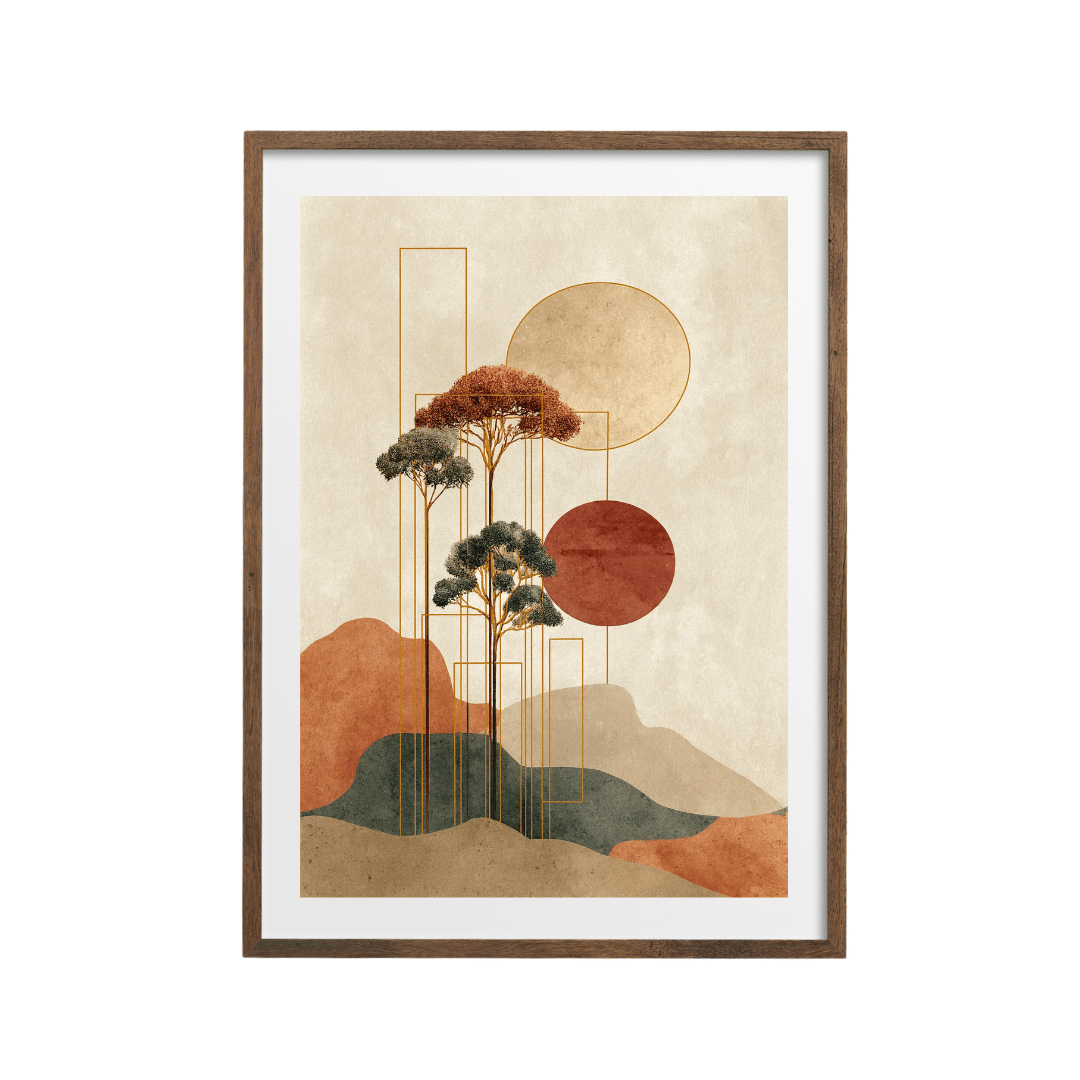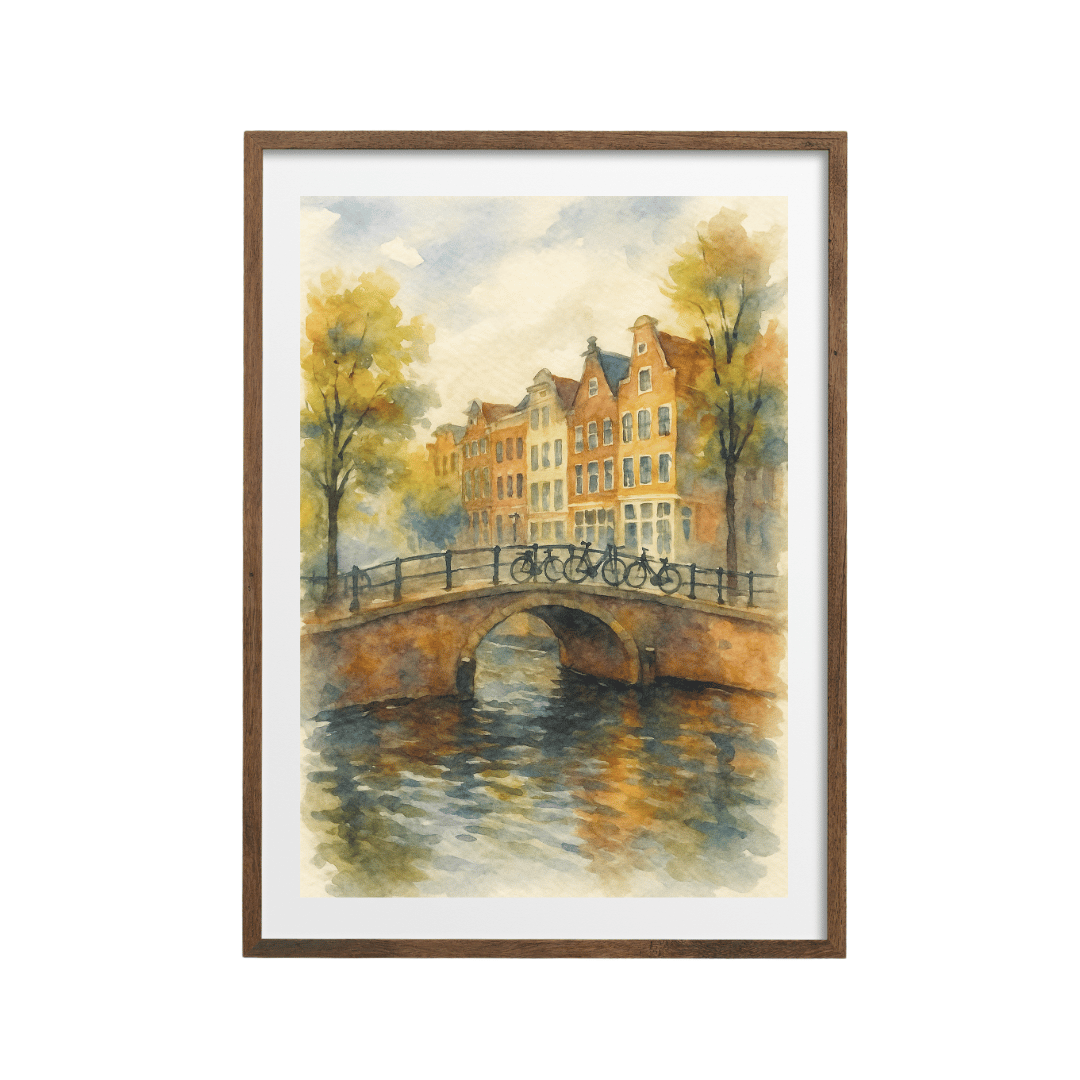






The best wall art for a small living room is usually one larger print rather than several small ones. Aim for art about two thirds the width of the sofa below it, so roughly 100 cm across over a 150 cm sofa. Vertical prints add height, and pale mounts and frames keep the wall feeling light.
Small rooms tempt people into small art. It feels sensible: little room, little pictures. In most homes I see, that instinct does the opposite of what people want. Six A4 frames dotted around a compact lounge give the eye six things to land on, and the walls start to feel busy and closer than they are. One confident piece gives the room a focal point and lets everything else go quiet.
Why one large print works better than lots of small ones
A single larger print reads as one shape. Your eye takes it in, settles, and moves on to the rest of the room. A cluster of small frames reads as a collection of separate objects, and every gap between them is another edge to process. In a room that's already short on floor space, that visual noise is what makes it feel cramped.
There's also a scale problem. Small art on a wall makes the wall look bigger by comparison, which sounds helpful until you realise it makes the art look lost and the furniture look oversized. A print that's properly sized to the sofa or sideboard below it pulls the whole arrangement together.
My rule of thumb: the art (including the frame) should be roughly two thirds the width of the furniture it hangs over. If it's on a bare wall, aim for about half to two thirds of the wall section you're filling.
| Furniture or wall width | Two thirds of that | Print size that fits |
|---|---|---|
| 120 cm (loveseat) | 80 cm | 50x70 cm landscape with a mount, or a pair of 30x40 cm |
| 150 cm (small two seater) | 100 cm | 60x90 cm landscape, or a pair of 40x50 cm |
| 180 cm (three seater) | 120 cm | A pair of 50x70 cm portrait prints with a 6 cm gap |
| 90 cm alcove | 60 cm | 40x50 cm or A2 |
Most prints come in sizes from 13x18 cm up to 60x90 cm, so you can nearly always find the right fit without going custom. If you're between two sizes in a small room, I'd go up rather than down.
How do vertical prints make a small living room feel taller?
Portrait prints draw the eye upwards. In a room where the floor area is limited, height is the dimension you can still play with, and a tall frame suggests a higher ceiling than you've got. This matters most in UK terraces and new builds, where ceilings are often on the lower side.
Where vertical art helps most
- Narrow walls between a window and a corner, where a landscape print would feel squeezed
- Either side of a chimney breast, as a matching pair
- Above a narrow console or a reading chair
- Behind a tall floor lamp, where the two shapes echo each other
A 50x70 cm portrait print hung with its centre at about 145 to 150 cm from the floor works on almost any wall. If it goes above a sofa, keep 15 to 25 cm between the top of the sofa back and the bottom of the frame. I've written a longer guide on how high to hang art above a sofa and how wide to go if you want the full set of measurements.
Stacking two prints vertically
If you love two pieces and can't choose, stack them one above the other rather than side by side. Two 30x40 cm prints with a 5 to 8 cm gap give you a tall column of about 85 cm, which works beautifully on a narrow strip of wall and keeps the vertical line going.
Choosing wall art for a small living room: colour and mounts
Light, soft palettes recede. Dark, high contrast pieces come forward. Neither is wrong, but you need to know which you're choosing.
If the room is short on light, a print with plenty of cream, sand or pale grey in it will sit back into the wall and keep things airy. Abstract landscapes with a low horizon line are good for this because the open space at the top of the image acts a bit like a window. Botanical line drawings on a warm off-white ground do the same job with less colour.
If you'd rather go darker, do it once. One moody navy or charcoal print on a pale wall can look deliberate and calm. Three of them will close the room in.
What a mount adds
A white or ivory mount (the card border between the print and the frame) is one of the cheapest ways to make a small room feel more spacious. It puts breathing room around the image, makes a mid-sized print look larger and more considered, and keeps the edge of the artwork away from a dark frame. In a compact living room I'd almost always pick a mount over a bigger print with no border.
Frame colour
Many prints offer black, white, wood and dark wood frames, or unframed if you've already got frames. For small rooms, white and pale oak frames are the easiest because they blend with most walls and skirting. Black frames work well on white or very pale walls if you want crisper edges. Dark wood looks great with mid-century furniture but adds weight, so keep it to one piece.
How to avoid clutter on small living room walls
Clutter on walls usually comes from accumulation rather than planning. A print here, a mirror there, a shelf of small frames, a clock. Each made sense on its own. Together they make the room feel crowded.
- Pick one main wall for art. Usually that's the wall behind the sofa or opposite the door, because it's what you see first.
- Leave at least one wall completely bare. That empty wall is doing a job: it gives the eye somewhere to rest.
- Limit the room to two or three frame finishes at most. One is even better.
- Keep a consistent gap of 5 to 8 cm between frames in any pair or group.
- Take everything down and live with one piece for a week before adding more. You'll often find you don't want more.
If you do want a gallery wall in a small space, keep it tight. Group the frames into a rectangle of no more than about 120 x 90 cm, use the same frame colour throughout, and choose prints that share at least one colour. A loose, sprawling gallery wall is the fastest way to make a small room feel smaller.
Renting and can't put many holes in the walls? That's actually a good reason to commit to one big piece. A single 50x70 cm frame needs two hooks, and I've covered other options in abstract art for rented flats you can't paint.
Which styles suit a compact living room?
Style matters less than scale and colour, but some styles are easier in small spaces.
Minimal abstracts with a few large shapes are the safest choice. They read clearly from across a small room and don't need much wall around them. The neutral geometric beige and black abstract is a good example: bold enough to be a focal point, quiet enough not to dominate.
Soft abstract landscapes, like the soft neutral abstract landscape or the warmer golden meadow abstract landscape, add depth because they suggest distance.
Fine line botanicals, such as the botanical flora drawing, suit rooms where you want something gentle. They work especially well in a thin oak frame with a wide mount.
Black and white photography like the misty grass print or the vase and branch still life brings atmosphere without adding colour to a room that might already have plenty going on in its soft furnishings.
For one dramatic piece, the navy and beige textured abstract works on a pale wall, and the beige and black brushstroke abstract gives you energy in a neutral palette.
You'll find more in the minimalist poster collection and the wider abstract art collection.
Shop the look


Quick answers
Should I put big or small art in a small living room?
Big, within reason. One print around two thirds the width of the sofa or wall section below it makes a small room feel calmer and more spacious than several small frames.
What size print should go above a small sofa?
For a sofa around 150 cm wide, a 60x90 cm landscape print or a pair of 40x50 cm prints works well. Hang it 15 to 25 cm above the top of the sofa back.
Do dark pictures make a room look smaller?
Dark, high contrast art comes forward visually, so several dark pieces can make a room feel tighter. One dark print on a pale wall usually looks fine and can add depth.
Is a gallery wall a bad idea in a small living room?
Not if it's tight and consistent. Keep it within roughly 120 x 90 cm, use one frame colour, and leave other walls bare.
Which frame colour makes a small room feel bigger?
White or pale oak frames with a white mount blend into most walls and keep the look light. Save black and dark wood for a single statement piece.