




I've lived in my fair share of rented flats, and almost all of them were magnolia. Magnolia walls, beige carpet, a white radiator under the window, and a tenancy agreement that said something stern about decorating. If that sounds like your place, I have good news: you can make a rented flat feel like yours without touching a paintbrush, and big abstract art is the quickest way I know to do it.
This is the approach I use with friends who rent, and it's the same thing I did in my own flats for years.

Let the print do the job paint would
When people can't paint, they often try to add colour through lots of small things: a cushion here, a vase there. It rarely works on a big pale wall, because each bit of colour is too small to register from across the room. One large print changes that. It puts a decent block of colour at eye level, right where you'd notice a painted wall.
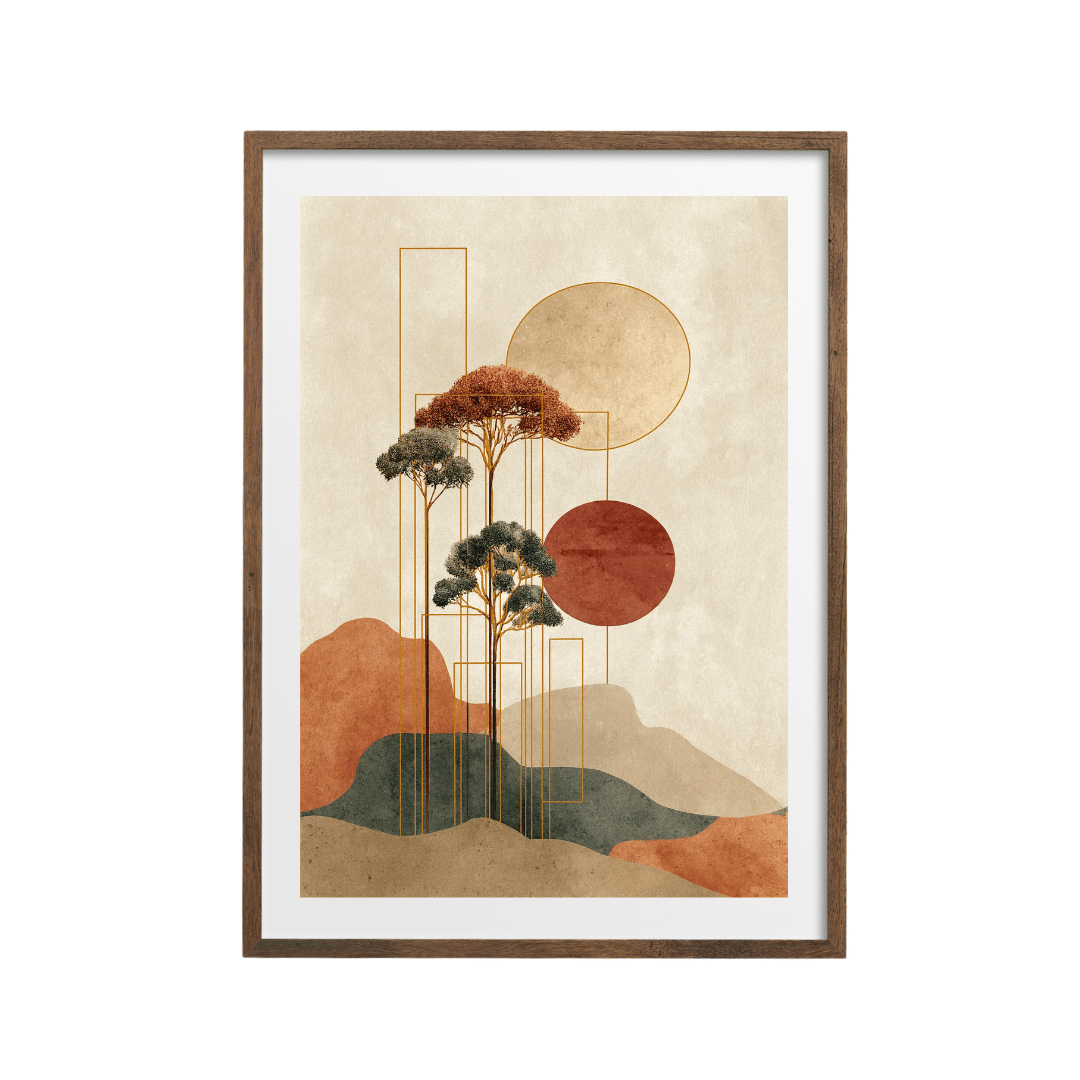
Magnolia is a forgiving backdrop. It's warm, so it gets on well with earthy colours: terracotta, olive, mustard, rust, warm browns. Those sit comfortably against a creamy wall where cold greys can look a bit grubby. The organic shapes print in olive and terracotta is the kind of thing I mean. It has enough colour to give the wall some life, and the palette suits a warm white.
If you want something a bit braver, go for strong colour with a clear shape. This geometric print with bold colours or the retro Bauhaus print in teal, orange and gold would both stand up well to a plain wall. For a looser, more playful feel, the colourful scribbles abstract is fun in a hallway or a small living room.

Go bigger than you think
Small flats push people towards small art, which I understand. It feels sensible. In practice, a handful of little frames dotted around a small room makes it feel busier, and the walls still look bare. One big print on the main wall reads as calmer and more deliberate, and it gives the room a focal point that has nothing to do with the landlord's choice of carpet.
The rule I use above furniture still applies: aim for art that's about two-thirds the width of the sofa, sideboard or bed below it. In a lot of rented living rooms that means a single large print instead of a gallery wall, which also means fewer things to hang. That matters when you're trying not to make holes.
Check your tenancy agreement first
Before you hang anything, read the bit of your tenancy agreement about decorating and fixings. Some landlords are fine with a few picture hooks as long as you fill the holes when you leave. Some ban nails and screws completely. Some say nothing at all, in which case I'd send a quick email to ask. It takes two minutes, and having it in writing helps when the deposit conversation comes round.
Whatever it says, the methods below avoid drilling, so they're usually the safest place to start.
Damage-free ways to hang art
Adhesive picture-hanging strips
These are the strips that grip the frame and the wall and come off with a pull tab. They're brilliant when they're used properly, and they fail when they aren't. Every pack states a maximum weight, so weigh your framed print (bathroom scales are fine) and buy strips rated comfortably above it. Use the number of strips the pack tells you for that weight, and stick them to clean, dry walls. Wipe the wall with a little rubbing alcohol first if it's been near a kitchen.
Two things I'm strict about. First, keep heavy glass frames off adhesive strips. A large frame with real glass is heavy, and if it lets go you have broken glass on the floor and a chunk out of the wall. Second, be careful with freshly painted walls and textured or flaky paint, because strips can peel the paint off with them. A lightweight frame with acrylic glazing is the best match for strips.
Picture ledges
A picture ledge is a narrow shelf with a lip at the front, and the prints just lean on it. You do need to fix the ledge to the wall, so it's two or three screw holes instead of none, but after that you can swap and rearrange prints as often as you like without any new holes. If your landlord is happy with a couple of fixings, this is my favourite option. Layer a big print at the back and a smaller one in front, slightly overlapping, and it looks relaxed and collected.
Leaning on a sideboard or the floor
No fixings at all. Stand a large framed print on a sideboard, a chest of drawers or a deep windowsill and lean it against the wall. It looks intentional as long as the print is big enough to hold its own, so go for something that covers a good chunk of the wall above the furniture. A small print leaning on a big sideboard just looks like you haven't got round to hanging it.
Very large prints can even lean straight on the floor, against the wall, which is a nice look in a bedroom or beside a sofa. If you have small children or pets, though, put a strip of museum putty or a small rubber bumper under the bottom edge so it can't slide, or skip this one entirely.

Pick prints that will move with you
Renting usually means moving every few years, so I'd buy art you'll still want in the next place. Abstracts are handy here because they don't belong to one room. The earth tones abstract would work in a living room now and a bedroom later. A neutral piece like the beige and black minimalist abstract will sit happily on whatever colour your next landlord picked.
Unframed prints are also easier to move than framed ones, and you can reframe them later when you know the room. Keep the tube they arrived in.

A simple plan for a magnolia living room
If I were starting from scratch in a rented flat this weekend, I'd do this. One large abstract with some warm colour above or leaning on the sofa wall or the sideboard. One smaller print on a ledge or strips in the hallway, so the colour carries through. And a rug or a throw that picks up one colour from the main print, which ties it all together without a drop of paint.
For more ideas, have a browse through the abstract art collection for colour, or the minimalist poster collection if you'd like something quieter for a small space. Prints start at £9.99, which is a lot cheaper than losing part of your deposit to a repaint.