



If I had a pound for every living room where the art above the sofa is hung too high, I'd have retired by now. It's the most common mistake I see, and it's an easy one to make. People hang a print at the height that feels right while they're standing up with a hammer, and then wonder why it looks lost once they sit down.
This is the practical one, with numbers. Grab a tape measure.

The two numbers that matter most
There are two measurements I use on every job, and they work together.
The first is the centre of the art, which should sit roughly 145 to 150 cm from the floor. That's around average eye level, and it's the height galleries tend to work to. It keeps the art connected to the room instead of floating up near the ceiling.
The second is the gap between the top of the sofa back and the bottom of the frame. I aim for about 15 to 25 cm. Less than that and the frame looks squashed, and you'll knock it with your head. Much more and the art stops relating to the sofa and starts to look like it's hanging on its own.
Usually these two numbers agree. If your sofa back is around 85 cm high and your print is 70 cm tall, hanging the bottom edge at 110 cm puts the centre at 145 cm and leaves a 25 cm gap.
When they disagree, I go with the sofa. A low-backed sofa with a small print might push the centre a bit below 145 cm, and that's fine. Above furniture, the relationship with the sofa matters more than the gallery rule. On a bare wall with nothing below it, stick to the 145 to 150 cm centre.
How wide should the art be?
Aim for the art to be about two-thirds the width of the sofa. You can go a little narrower or a little wider, but somewhere between about 60% and 75% of the sofa's width tends to look right.
Some quick examples:
- A 180 cm two-seater wants art about 120 cm wide in total.
- A 210 cm three-seater wants art about 140 cm wide.
- A 300 cm corner sofa is trickier. Measure the side that sits against the main wall and work from that length.
"In total" is the important bit. That width can come from a single print, a pair or a set of three, as long as you count the gaps between the frames.
Never let the art be wider than the sofa. It makes the sofa look small and the wall look top-heavy.
One print, a pair or a trio?
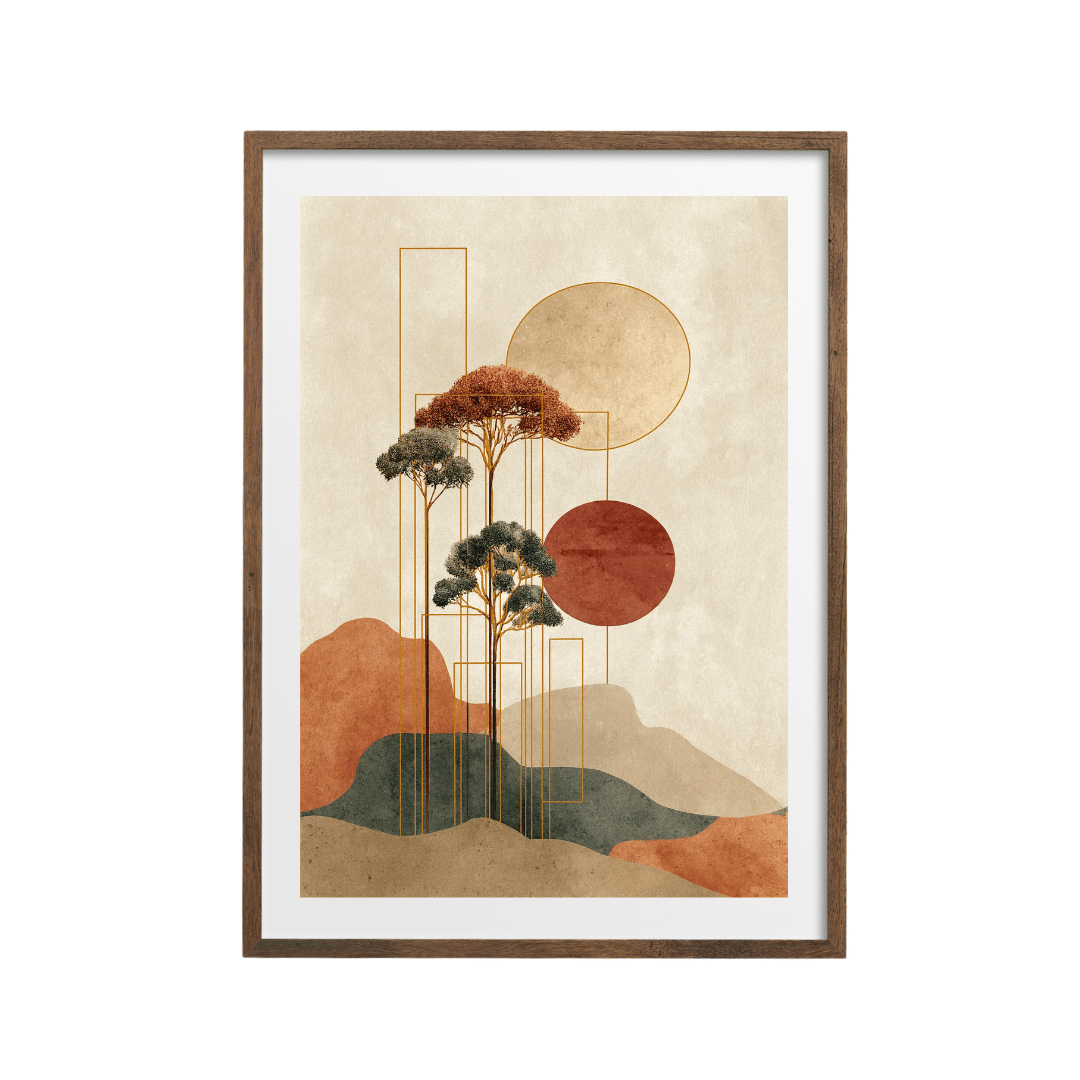
A single large print is the simplest option and often the most striking. It suits modern rooms, abstracts and anyone who doesn't fancy drilling lots of holes. Something like this neutral abstract landscape or the minimal green abstract landscape works well as one big piece, because the horizontal shapes echo the line of the sofa.
If a print big enough to reach two-thirds feels like a lot, two or three medium prints get you to the same width more cheaply and are easier to carry home.
Hanging a pair
Two prints of the same size, side by side, is a classic look above a sofa. Keep the gap between them small, about 5 to 8 cm. A bigger gap makes them read as two separate things instead of one pair. Centre the gap over the middle of the sofa, and line up the tops and bottoms of both frames exactly.
Pairs work best when the two prints obviously belong together. The white daisy print and the soft blue botanical would make a gentle pair in a calm, pale living room.

Hanging a trio
Three prints in a row is my favourite option for a long three-seater. Use the same gap between each frame, again around 5 to 8 cm, and keep the frames identical in size and colour. The middle print sits centred over the sofa, with the other two either side.
Line art is great for this, because three simple drawings in matching frames look tidy without being dull. The vintage ink sketch of vase florals, the beige botanical line art and the wildflower line drawing would sit together nicely as a set.

For a pair or trio, the 145 to 150 cm rule applies to the centre of the whole group, and the 15 to 25 cm gap applies to the bottom edge of the frames.
The paper-template trick
This is the bit that saves you from extra holes in the wall, and I do it on every single job.
- Cut a piece of paper to the exact size of each frame. Brown parcel paper, old wrapping paper or taped-together newspaper all work.
- Stick the templates to the wall with low-tack masking tape at the heights and gaps you've worked out.
- Step back. Sit on the sofa. Walk in through the door. Leave them up for a day if you can.
- Adjust until it looks right. It's much easier to move a bit of paper 3 cm than to fill a hole.
- Mark where the hook goes on each template. Measure from the top of the frame down to the hanging wire or D-ring when it's pulled tight, and mark that distance on the paper.
- Drill or hammer straight through the mark on the paper, then tear the template away.
The template also tells you whether you've got the size right before you buy. If the paper looks tiny above your sofa, the print will too.

A few things that trip people up
Measure to the wire as well as the frame. The hook sits below the top of the frame by however much the wire or D-ring drops, and forgetting that is why so many prints end up a few centimetres higher than planned.
Use two hooks for anything wide. A single hook lets a long frame tilt every time someone leans back on the sofa. Two hooks keep it level.
Check for pipes and cables before you drill. A cheap detector is worth having, and wiring often runs straight up or down from sockets and switches.
Use a spirit level, and trust it over your eye. Old houses have wonky ceilings and skirting, so measuring down from the ceiling can throw you off.
Ready to measure?
Write down three numbers: the width of your sofa, the height of its back and two-thirds of that width. With those, you'll know how wide your art should be and where its bottom edge goes. Then cut a paper template and live with it for a day.
If you need something to fill the space, the abstract art collection has plenty of big single pieces, the botanical prints collection is good for pairs, and the line art collection is ideal for a trio. Prints start at £9.99, so you can try a set without spending a fortune.